
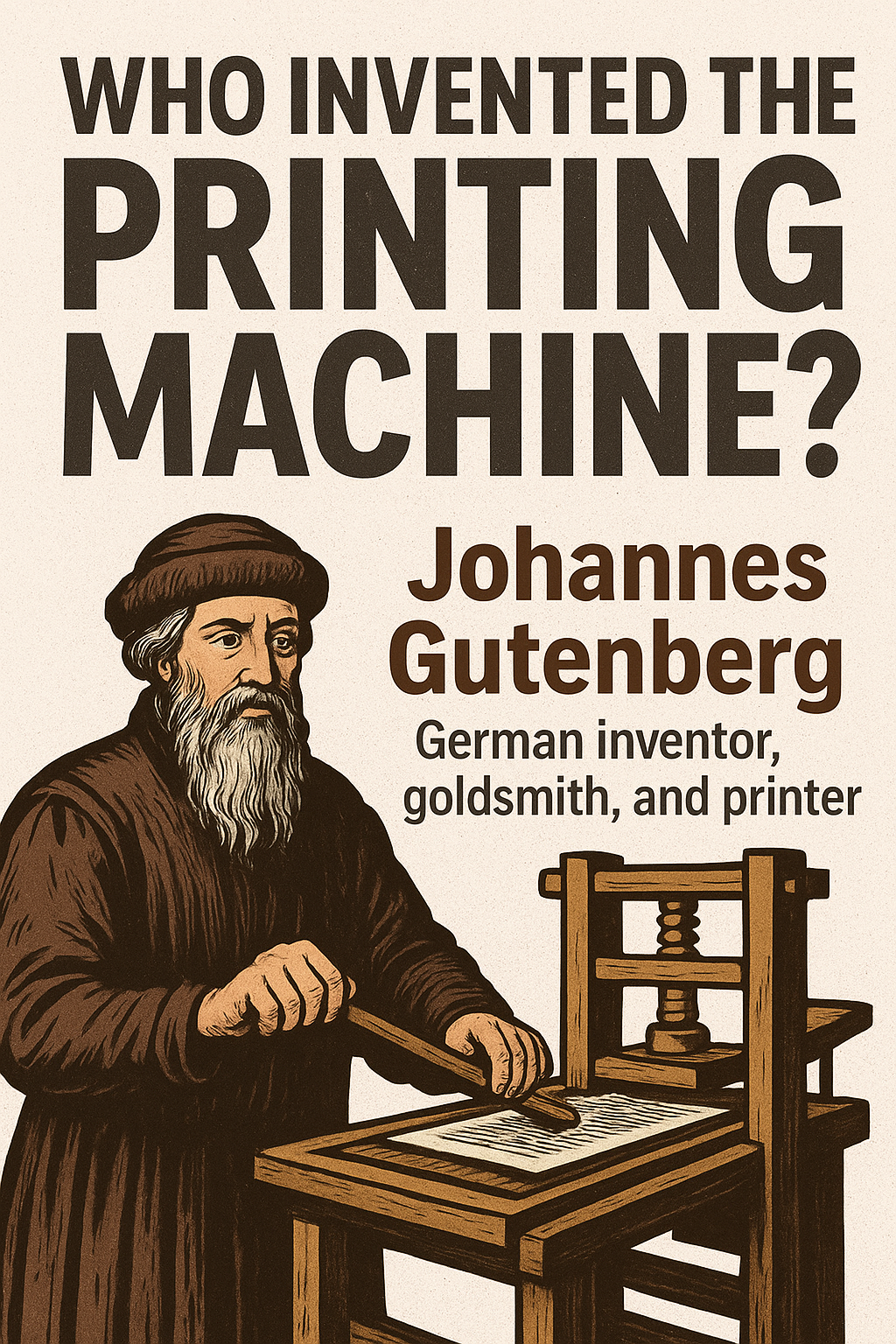
Johannes Gutenberg Invented the Printing Machine
The invention of the printing machine is one of the most important milestones in human history. It completely transformed the way knowledge, ideas, and information were shared across the world. The credit for this revolutionary invention goes to Johannes Gutenberg, a German inventor, goldsmith, and printer who lived in the 15th century.
The Genius Behind the Printing Revolution
Around 1440, Johannes Gutenberg invented the movable-type printing press in Mainz, Germany. Before his invention, books were copied by hand — a slow and expensive process that limited access to knowledge. Gutenberg’s printing press used movable metal type, ink, and a wooden press, allowing printers to produce multiple copies of a page efficiently.
The First Printed Book – The Gutenberg Bible
In 1455, Gutenberg printed his most famous work — the Gutenberg Bible, also known as the 42-line Bible. It was the first major book printed using movable type. This masterpiece marked the beginning of the “Gutenberg Revolution”, leading to the rapid spread of education, science, religion, and culture throughout Europe.
How Printing Changed the World
The printing press made it possible to:
- Mass-produce books and newspapers
- Spread new ideas quickly
- Boost literacy rates
- Preserve and share cultural and scientific knowledge
It played a key role in major world movements such as the Renaissance, Reformation, and Scientific Revolution.
Modern Printing – From Gutenberg to Digital Age
Today, printing technology has evolved far beyond Gutenberg’s wooden press. We now have offset printing, digital printing, 3D printing, and more — making printing faster, cheaper, and more versatile than ever before. But it all started with one man’s brilliant idea over 500 years ago.
In short:
Johannes Gutenberg didn’t just invent a machine — he invented a revolution that still shapes our world today.